
The Cognassist cognitive assessment
The cognitive assessment that sees every learner, from day one
Every learner completes it at onboarding, no specialist required. It is the Assess stage of the APDR cycle (assess, plan, do and review): the front door of the platform, and the start of the evidence trail.
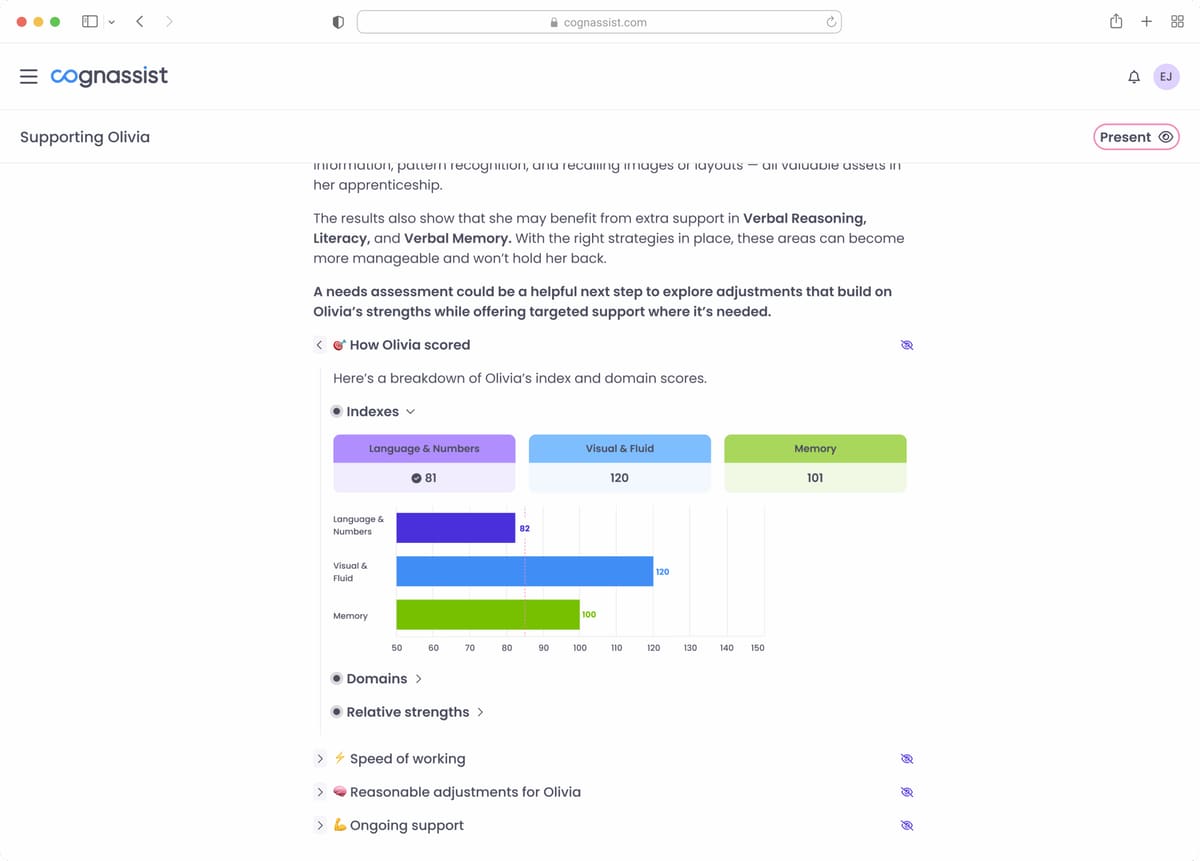
A cognitive assessment for every learner, not only those who disclose
Cognitive diversity is far broader than neurodiversity: nine in ten of us have at least one of the nine cognitive domains sitting above or below the average range. Disclosure and onboarding questionnaires only capture what a learner already knows about themselves and chooses to declare, so most cognitive differences stay hidden.
- Whole-cohort at enrolment: every learner completes the assessment, not only those who self-declare or arrive with a diagnosis.
- Performance-based, not self-report: it measures how each learner actually thinks and learns, surfacing needs a questionnaire cannot.
- No specialist required to run the assessment, read the results, or generate the initial support plan.
Self-guided in about 30 minutes, with a practice run before every task
Learners complete the assessment on their own, in a modern desktop browser. A practice question sets up each task, and there is a break option partway through. It is taken in one sitting, and the framing stays strengths-forward throughout.
- Independent and self-paced in a modern desktop browser.
- A practice question before each task, and a break option halfway through.
- The invitation fires automatically when a learner enrols, so there is no admin per learner.
What it measures
Nine cognitive domains, across three cognitive indexes
The Cognassist cognitive assessment for learners, NeuroMap, measures nine cognitive domains grouped into three cognitive indexes: Language & Numbers, Visual & Fluid, and Memory.
A cognitive diversity report a tutor can act on from day one
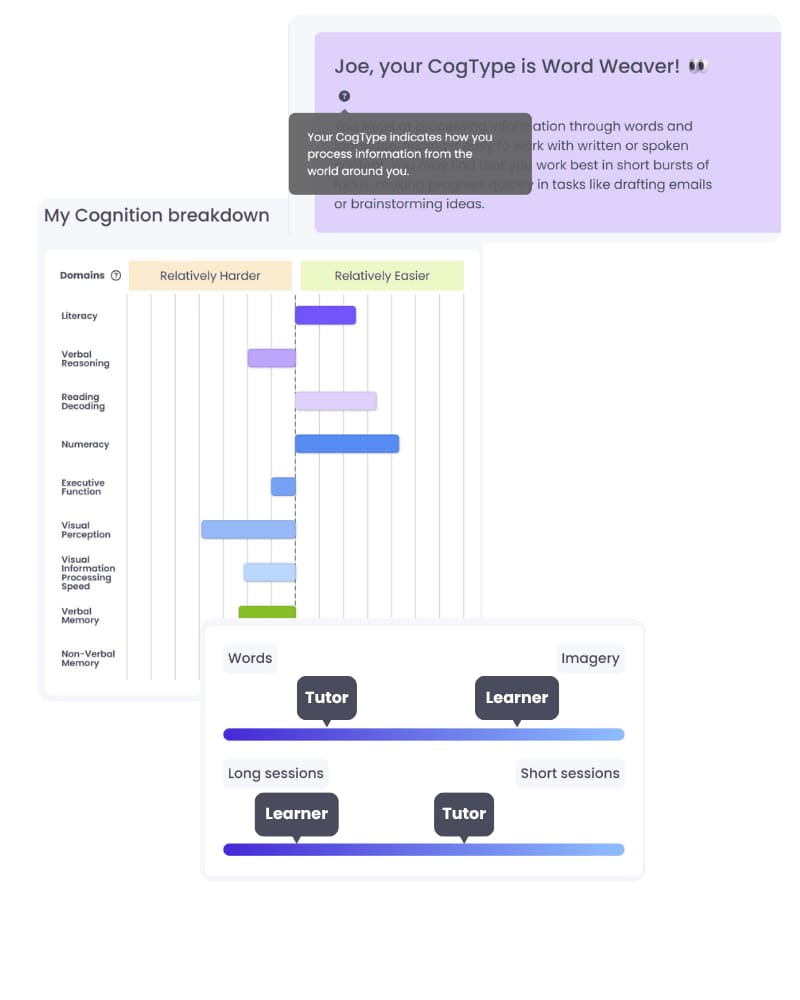
The assessment turns into something a tutor can use straight away. Every learner gets a strengths-forward cognitive diversity report: each domain shown relative to their own profile, as relatively easier or relatively harder, never as a deficit, with a plain-language CogType that makes the result easy to talk about.
- Tutors get standardised scores for every domain and index, in one clear report.
- A classification signal (Consider needs assessment, Monitor and review, or No need identified) guides the tutor's judgement. It is a signal, never a diagnosis or a verdict.
- Suggested adjustments flow straight into Plan360, the start of the golden thread that runs through plan, do and review.
Where it sits: the Assess stage of the APDR cycle
The assessment is the first stage of the graduated approach. What it surfaces feeds every stage that follows, so support, delivery and review all trace back to an assessed need. This is the golden thread.
Step 01 of 04
Assess
Every learner completes the cognitive assessment at onboarding, surfacing cognitive strengths and needs across the whole cohort.
- Whole-cohort, no specialist required
- A cognitive diversity report on every learner
Step 02 of 04
Plan
Suggested adjustments become a personalised support plan, co-created by tutor and learner.
- Built from the assessed need, not guesswork
Step 03 of 04
Do
Tutors deliver everyday support in the flow of teaching, and record it as they go.
- Support becomes evidence as a by-product
Step 04 of 04
Review
Progress is reviewed and the plan adjusts, so support stays responsive over time.
- The evidence trail stays current
Customer story · Bedford College Group
Whole-cohort inclusion, proven across a college group
Bedford College Group piloted the cognitive assessment across three colleges and four curriculum areas, giving every learner the same identification at the start, then committed to rolling it out to every learner.
“The alternative was to increase our specialist resource fivefold. The trial gave us confidence that Cognassist can deliver what we need to empower our existing tutors to provide high-quality, personalised learning support at a scale that specialist teams alone could never reach.”
- 400,000+
- learners assessed (as of 2026)
- 150+
- organisations supporting learners
- Since 2017
- in education and skills
- Levels 1 to 7
- supported
The new Tutor Report simplifies what was previously complex and clearly shows what support to provide from day one of a learner's programme.
Validated to recognised standards, and open to scrutiny
The assessment is built to recognised psychometric standards, reviewed by PATOSS (the professional association for specialist assessors), and developed with an independent Science Advisory Board. We do not ask you to take that on trust. The normative sample, reliability, validity and independent scrutiny are all set out in full on the science and evidence page.
Explore the platform
Keep exploring
See the evidence behind the assessment, read how providers use it, or step back to the whole platform.
The science and evidence
The normative sample, reliability, validity and independent scrutiny behind the assessment.
ExploreCustomer stories
How providers like yours put the assessment to work, in their own words.
ExploreThe platform
How assess, plan, do and review work together as one inclusion workflow.
Explore
FAQ
Questions buyers and practitioners ask
What is a cognitive assessment?
A cognitive assessment measures how a learner thinks and learns, rather than what they already know. The Cognassist cognitive assessment for learners is performance-based: it works across nine cognitive domains to produce a strengths-forward profile and a signal for support. It is not a diagnosis.Does every learner take it?
Yes. It is a whole-cohort cognitive assessment: every learner completes it at onboarding, not only those who self-declare or arrive with a diagnosis. That is how cognitive differences are surfaced early, rather than missed.Do we need a specialist?
No. No specialist is required to run the assessment, read the results, or generate the initial support plan. A confident tutor can act on the report from day one, and specialist expertise stays reserved for the most complex needs.How long does it take?
About 30 minutes. Learners complete it independently in a modern desktop browser, in one sitting, with a practice question before each task and a break option partway through.Is it a diagnosis?
No. The assessment measures the cognitive differences associated with specific learning differences to inform a tutor's professional judgement. It is a signal, never a verdict, and it never detects or diagnoses dyslexia or any other condition. It does not by itself establish disability under the Equality Act 2010, and the resulting adjustments are good inclusive practice, not legal determinations.Is it a test or an exam?
No. It is an assessment, not a test or an exam. There is no pass or fail: it describes how a learner thinks and learns so support can be tailored to them.Is it validated?
Yes. It is built to recognised psychometric standards, reviewed by PATOSS and developed with an independent Science Advisory Board. The normative sample, reliability, validity and independent scrutiny are set out in full on the science and evidence page.We already run a management information system (MIS) or e-portfolio. What does the assessment add?
Your MIS or e-portfolio stores the learner records you put into it. The cognitive assessment generates something those systems cannot: a performance-based signal on how each learner thinks and learns, the input they depend on. It fits alongside them, with the invitation firing automatically on enrolment, whether you connect your MIS, use our public application programming interface (API), or add learners manually.Can it help with extra time in assessments?
The assessment includes a separate Speed of Working result that gives standardised evidence towards additional-time arrangements, accepted by most awarding organisations at qualification and end-point assessment stage. Formal exam access under a Form 8 needs a separate specialist assessment.
See the assessment at work
Book a demo and we will show you the cognitive assessment, the report a tutor sees, and how it feeds the rest of the platform.