
Reasonable adjustments
Reasonable adjustments, delivered in everyday teaching and evidenced as they happen
The Do and review stage of the APDR cycle (assess, plan, do, review). Reasonable adjustments software that delivers agreed support in everyday teaching and makes the evidence audit-grade as it happens, not reconstructed before an audit.
Reasonable adjustments delivered in the flow of teaching, by the tutor who knows the learner
The reasonable adjustments Cognassist recommends (ProAdapt) are delivered as the everyday way of learning, by the tutor who already knows the learner, not routed to a separate specialist queue. Each one is course-personalised and carries its purpose from the assessment, so this is the third link of the golden thread from Assess and Plan.
- Course-personalised to the learner's programme and subject, not generic advice.
- Each adjustment carries its Intent, Implementation and Impact (the Three I's): what it is for, how it is delivered, and the difference it should make.
- Built on an assessment that signals where to look, for a tutor's judgement. It is not a diagnosis, and the adjustments are good inclusive practice, not legal determinations.
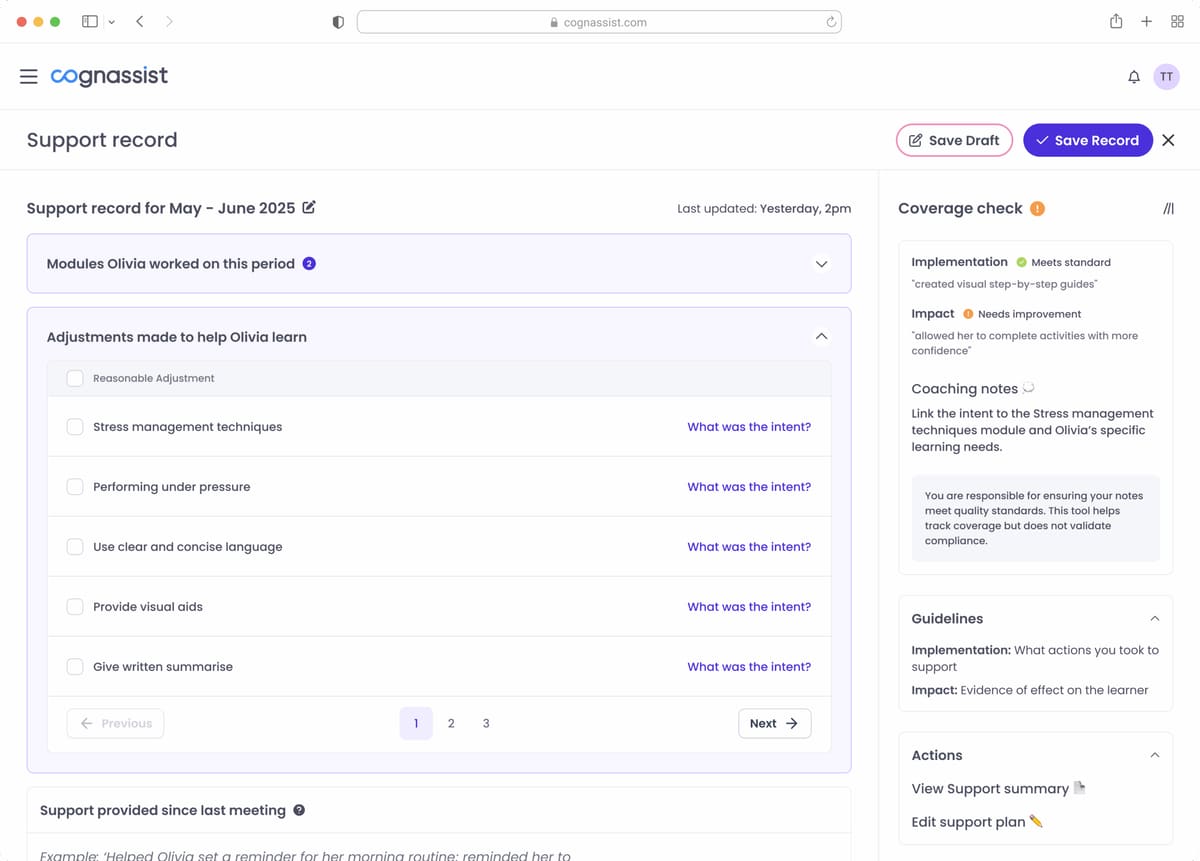
The Coverage Checker coaches every record to the standard, as you write it
The Coverage Checker scores each support record in real time against the Three I's, coaching the quality of the record as you write it with a simple red, amber, green (RAG) signal: green meets the standard, amber needs more, red is still blank.
- It shows Intent, Implementation and Impact feedback plus coaching notes at the point of entry, so a non-specialist gets better at both evidencing and delivering support.
- Good, audit-grade evidence becomes a by-product of everyday practice, not a document reconstructed before an audit.
- Its reasoning is AI-generated, shown with an in-app disclaimer: a guide for your judgement, never a clinical or legal verdict. It scores support records, not Ofsted reports.
An audit-grade evidence trail, produced as a by-product of everyday support
Records kept to the Three I's standard, with an all-green Coverage Checker, are audit-grade evidence of good inclusive practice, whether or not you ever claim any funding. The golden thread makes it defensible: every support record traces back through the adjustment to the assessed need, so an auditor can read it end-to-end.
- The admin is light: at review the tutor selects the adjustment they supported, confirms delivery and notes the impact. The why comes with the adjustment, from the assessment.
- Evidence is captured as it happens, not reconstructed in a scramble before an audit.
- This is what Ofsted's graduated approach looks for. It helps you evidence inclusion; it does not make you compliant, and no regulator requires or approves it.
Where it sits: the Do and review stage of the APDR cycle
Do and review is the third step of the graduated approach. What the assessment surfaced in Assess and the plan agreed in Plan is now delivered, recorded and reviewed, and every record traces back to an assessed need. This is the golden thread. You are looking at Do and review.
Step 01 of 04
Assess
Every learner completes the cognitive assessment at onboarding, surfacing strengths and needs across the whole cohort.
- A cognitive diversity report on every learner
Step 02 of 04
Plan
Suggested adjustments become a personalised support plan, co-created with the learner.
- Built from the assessed need, agreed together
Step 03 of 04
Do
Tutors deliver the agreed adjustments in the flow of teaching and record support as they go, with the Coverage Checker coaching each record to the standard in real time.
- Support becomes audit-grade evidence as a by-product
You are here
Step 04 of 04
Review
Support is reviewed by recording against the Three I's each month and re-walking the plan with the learner: keep it, update it, or step the learner off with evidence.
- Stepping a learner off support, with evidence, is success
You are here
Customer story · Bedford College Group
An auditable evidence trail that holds up at scale
Bedford College Group piloted Cognassist across three colleges and four curriculum areas. Every interaction is recorded, creating an auditable evidence trail from identification through to review, the kind of institutional-level evidence of inclusion Ofsted looks for. That defensible, whole-provider trail is what gave them the confidence to commit to rolling it out to every learner.
“The trial has demonstrated that Cognassist has the ability to work effectively at an institutional scale, the results we've seen have given us the confidence to commit to a full rollout to every learner from September”
Discussing Reasonable Adjustments through the Support Record is really beneficial as it helps explore how the adjustments are being applied in the workplace as well as in college. The AI checker is a helpful guide to ensure you're heading in the right direction.
Turn everyday support into evidence Ofsted can see, not just describe
The audit-grade records this stage produces are what evidence inclusion across your whole provision under the renewed Ofsted framework: inclusion you can show, not just describe. Evidencing inclusion for Ofsted is a job of its own, from the whole-provider evidence trail to leadership oversight, and we have a guide to exactly that.
Explore the platform
Keep exploring
See where the support that gets delivered comes from, hear how providers use it, or step back to the whole platform.
The cognitive assessment
The Assess stage, where the need is first surfaced.
ExploreThe support plan
The Plan stage, where the adjustments that get delivered are agreed.
ExploreCustomer stories
How providers put delivered, evidenced support to work, in their own words.
ExploreThe platform
How assess, plan, do and review work together as one inclusion workflow.
Explore
FAQ
Questions buyers and practitioners ask
What is reasonable adjustments software?
It is software that helps you deliver and evidence the reasonable adjustments a learner needs. In Cognassist it is the Do and review stage of the APDR cycle (assess, plan, do, review): agreed adjustments are delivered in everyday teaching, then recorded against the Three I's, and the Coverage Checker coaches each record to the standard in real time, so the evidence is audit-grade as it happens.How do you evidence reasonable adjustments in Cognassist?
You record what you delivered against the Three I's (Intent, Implementation and Impact), and the Coverage Checker scores the record red, amber or green in real time. Because every record traces back through the adjustment to the assessed need, the evidence is audit-grade as it happens, not reconstructed before an audit. That is what learning support evidence software should do: make good evidence a by-product of the work.What is the Coverage Checker?
The Coverage Checker is real-time record-quality coaching. It scores each support record against the Three I's with a red, amber, green signal: green meets the standard, amber needs more, red is still blank. It shows Intent, Implementation and Impact feedback plus coaching notes as you write. It coaches the quality of your record; it does not generate an Ofsted report, and no regulator requires it. Its reasoning is AI-generated and shown with an in-app disclaimer.Do the Three I's make us Ofsted-compliant?
No. The Three I's (Intent, Implementation and Impact) are a valid, sensible way to evidence good practice, not an Ofsted requirement. Cognassist helps you evidence inclusion; it does not make you compliant, and no regulator requires or approves it. Compliance is yours; we make the evidence easier to produce and to defend.We already record support in our management information system (MIS) or e-portfolio. What does the Coverage Checker add?
Your MIS or e-portfolio stores the records you write. The Coverage Checker coaches the quality of each record as you write it, in real time, and makes the evidence audit-grade: the record-quality layer a system of record does not give you. It sits in your workflow alongside the tools you already run, rather than replacing them.Do I need to be a specialist?
No. The platform does the heavy lifting: the adjustment carries its intent from the assessment, so recording good, evidenced support takes a few clicks, not a specialist qualification. Professional judgement still guides how you deliver support, and specialist expertise stays reserved for the most complex needs.How does review work?
Two rhythms. Each month you record support against the Three I's. Periodically you review the whole plan by re-walking it with the learner and deciding together: keep it, update it, or step the learner off support. Stepping a learner off, with the evidence to show why, is success.Is the assessment behind it a diagnosis?
No. The adjustments trace to an assessment that measures the cognitive differences associated with specific learning differences, a signal for a tutor's judgement, never a diagnosis. A cognitive profile does not by itself establish disability under the Equality Act 2010, and the adjustments are good inclusive practice, not legal determinations.
See delivered, evidenced support at work
Book a demo and we will show you how the agreed adjustments are delivered in everyday teaching, coached to an audit-grade record in real time, and reviewed with the learner.