
Ofsted inclusion readiness
Inclusion is now graded on its own. Evidence it, don't just describe it.
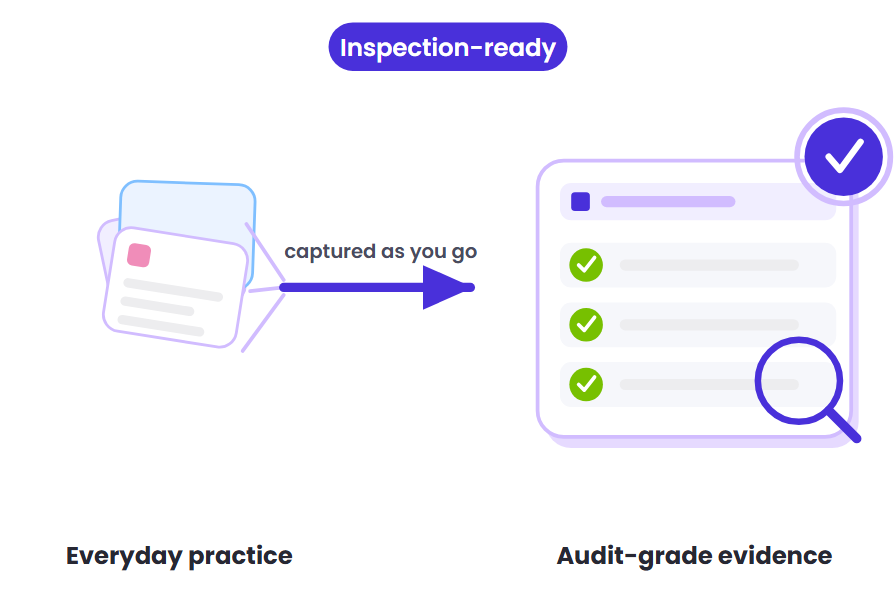
Under the renewed Ofsted framework, inclusion is its own graded judgement, assessed whole-provider on evidenced impact. Cognassist turns everyday support into audit-grade evidence.
- 10 Nov 2025
- Renewed Ofsted framework in use
- Its own grade
- Inclusion, judged whole-provider
The gap inspectors see
Describing inclusion is not evidencing it.
Ofsted inclusion readiness is no longer about describing good intent. A graded, whole-provider judgement rewards evidenced impact. Self-disclosure, tutor instinct and scattered notes show activity, not impact, and give leaders no line of sight across the provider.
- The e-portfolio or management information system (MIS) you already run files what a tutor wrote. It does not coach whether that record meets the standard.
- And it gives leaders no whole-provider view of whether inclusion is actually landing.
- Cognassist adds both, on top of the system you already run: inclusion you can evidence, not just describe.
The golden thread
The golden thread: what makes the evidence audit-grade.
Audit-grade evidence is not a document you write for inspection. It is the trail your everyday support already leaves, when each step links to the next. Cognassist maintains that link, so a normal monthly record is the evidence.
Assessed need
The cognitive assessment flags a domain that may need support: a potential barrier, in the learner's course context. A signal for tutor judgement, not a diagnosis.
Matched reasonable adjustment
A recommended adjustment is linked to that need, carrying its Intent: what it is meant to change.
Support plan
The adjustment flows into the learner's support plan, co-created with them.
Delivery
Support is delivered as part of everyday teaching and coaching.
Monthly support record
Each month the tutor records the support against Intent, Implementation and Impact.
Leadership oversight
Leaders see it land across the whole provider, and act on gaps before they become findings.
Where the evidence is generated
Every support record, coached to the standard as it's written.
The Coverage Checker reviews each monthly support record in real time against Intent, Implementation and Impact, with coaching notes and a simple signal: green meets the standard, amber needs more, red is still blank. Records are audit-grade at the point of entry, not fixed up before an inspection.
- This is the record-quality layer a system of record does not give you: it shapes the record as it is written, not just stores it.
- Non-specialists produce good, evidenced support; your specialists are amplified, not replaced.
- It coaches the record; it does not generate an Ofsted report. The evidence is a by-product of doing the work well.
Where leaders oversee it
Whole-provider line of sight, so you act on gaps before findings.
Insights gives admins a live view across the whole provider: the share of learners moved off proactive support, the six-stage proactive pathway with per-tutor timeliness, learner and tutor adoption, and org-wide evidence-quality month by month. You evaluate strategy against outcomes and close the gaps an inspector would find.
- Org-wide evidence-quality is the oversight a storage system cannot give: whether records meet the standard, month by month, across every tutor.
- This is the active, data-led leadership Ofsted looks for across inclusion and additional needs: read the data, evaluate strategy, drive improvement.
- Admin-only. Insights is a leadership surface, not a tutor view.
Proof · Educationwise Academy
Inclusion embedded into quality, ahead of a first full Ofsted.
Educationwise Academy built the cognitive assessment into initial assessment and its quality-assurance framework before its first full inspection. Support stopped depending on who disclosed a need or which tutor happened to notice.
“By bringing Cognassist in, we were definitely able to identify a lot more learners and it highlights those additional needs that we wouldn't have known... We also have used some of the Cognassist assessment tools to be able to go to end-point organisations and look at reasonable adjustments, so we can use that as evidence.”
- OutstandingOfsted rating
- 12 monthsOfsted turnaround
- EqualAchievement for high-needs learners
Proof at breadth
The same result across colleges, training providers and universities.
One provider type does not prove another. Here is inclusion evidenced across all three.
Learners with special educational needs receive appropriate support. Leaders have introduced a diagnostic assessment to identify learning difficulties more rapidly.
Assessment, tracking and monitoring of progress is thorough and effective... They make good use of electronic systems to monitor learners' progress and intervene quickly and effectively when difficulties arise.
Academic tutors support apprentices with additional learning needs well. Apprentices acquire the skills they need to succeed through a specialist online learning tool, which UCEM offers to help apprentices reach their full potential through cognitive assessment...
Go deeper
Keep building your Ofsted inclusion readiness.
Leadership oversight in Insights
The whole-provider view leaders use to act on gaps early. Admin-only.
ExploreHow support records build the evidence
Reasonable adjustments and the Coverage Checker, where the golden thread is generated.
ExploreSee how providers like yours use Cognassist
Colleges, training providers and universities, in their own words.
ExploreFind your provider type
FE college, training provider or higher education apprenticeship team.
Explore
FAQ
Honest answers to the questions leaders actually ask.
How does Cognassist help us evidence inclusion for the standalone inclusion judgement?
It turns everyday support into audit-grade evidence. An assessed need links to a matched reasonable adjustment, which flows into the support plan, is delivered, and is recorded monthly against Intent, Implementation and Impact. This is the golden thread: the evidence exists as a by-product of good practice, traceable back to the original barrier.We already record support in our e-portfolio or MIS. What does Cognassist add?
Your system of record stores what a tutor wrote. Cognassist coaches record quality against Intent, Implementation and Impact at the point of entry, so records are audit-grade rather than simply filed, and gives leaders org-wide evidence-quality oversight across every tutor. Both sit on top of the system you already run; it stays your system of record.Does Cognassist make us Ofsted-compliant or guarantee a grade?
No. Cognassist helps you evidence inclusion and its impact; the inspection outcome is yours. This is a way to demonstrate active, evidenced practice, not a guarantee of a grade or of compliance.Does this work for colleges, training providers and universities?
Yes. It works across all Ofsted-inspected further education and skills providers, and higher education teams delivering apprenticeships. The golden thread is the same wherever inclusion is delivered.Do we get a one-click Ofsted-ready report?
No, and we would not claim to. Audit-grade evidence is a by-product of everyday practice, and you can export it: per-record support-record PDFs and bulk Evidence CSVs, straight from the platform.Are the Three I's an Ofsted requirement?
No. Intent, Implementation and Impact are a valid way to evidence support, aligned with what inspectors and funding auditors look for. They are our methodology, not a clause in the framework.Who can see the oversight dashboard?
Admins. Insights is an admin-only leadership surface; tutors work in their own records and plans, not the whole-provider dashboard.Is the cognitive assessment a diagnosis?
No. It produces a cognitive profile that signals where a learner may need support, to inform a tutor's judgement. It is not a clinical diagnosis and does not by itself establish disability under the Equality Act.
Be ready to evidence inclusion, not just describe it.
Show active, evidenced, whole-provider oversight of inclusion, audit-grade by design, built from the support you already deliver.