
Cognassist platform overview
The whole Cognassist platform, in one honest tour
Assess, Plan, Do & review, and Leadership & Governance: every Cognassist capability explained properly, ungated, with nothing live claimed that isn't.
How the platform is organised
The Cognassist platform overview: four pillars, one connected platform
Every learner completes the cognitive assessment at enrolment, no specialist required.
A non-specialist drafts a personalised support plan in minutes, built from the assessed need.
Reasonable adjustments are delivered in everyday teaching, evidenced automatically as you go.
Leaders get one real-time view of inclusion; every tutor gets on-demand, role-based training.
Every learner identified at enrolment, without a specialist hour
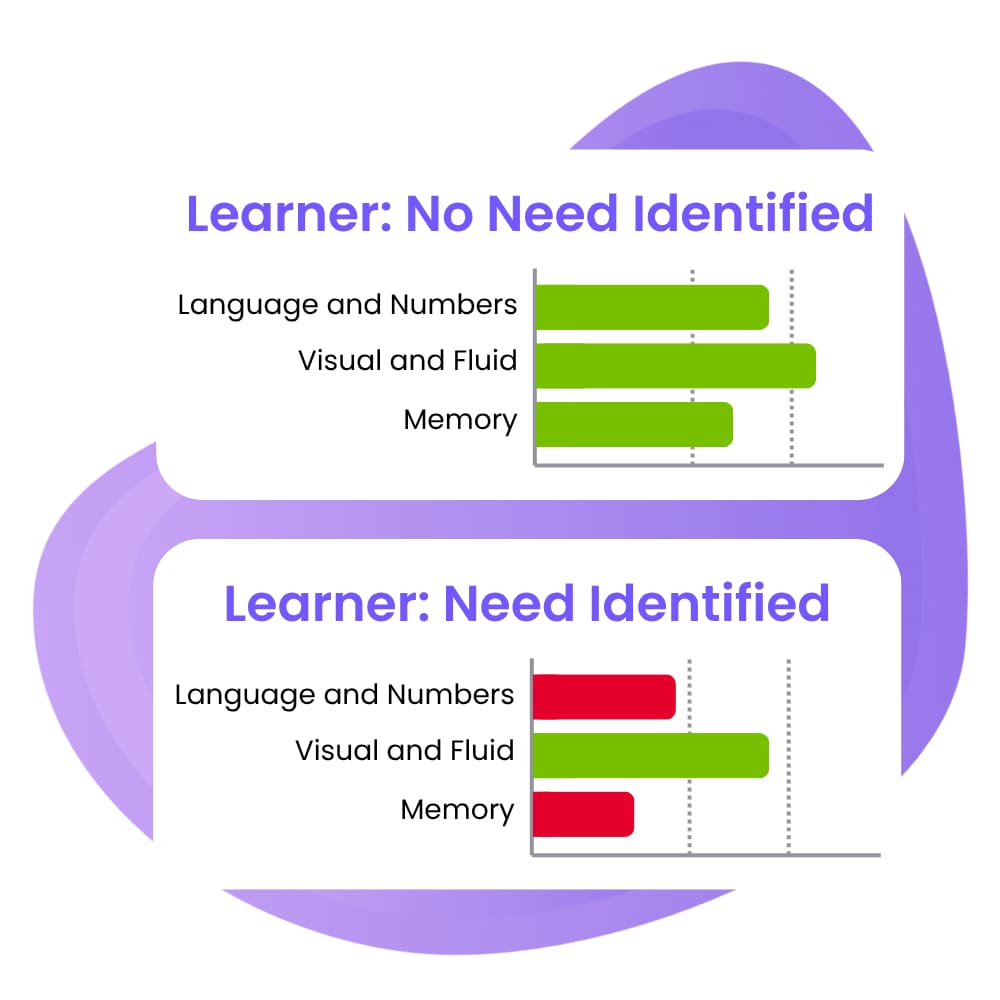
Cognitive differences don't wait for a learner to disclose them, or a tutor to spot them. The Cognassist cognitive assessment (NeuroMap) is whole-cohort: every learner completes it at enrolment, no specialist required to run it, read it, or generate the first support plan.
- Nine cognitive domains across three indexes: Language & Numbers, Visual & Fluid, Memory.
- A strengths-forward cognitive diversity report for every learner, plus a classification signal for a tutor's professional judgement, never a diagnosis.
- Feeds straight into the support plan: the first link of the golden thread.
Context captured before the conversation even starts
Known Barriers documents a learner's additional context and disclosures ahead of the needs-assessment meeting. What would otherwise be an undocumented judgement call becomes evidence, before the conversation happens, not reconstructed after it.
- Captures the additional context and disclosures a tutor would otherwise rely on memory for.
- Sits ahead of the needs-assessment meeting, so the conversation starts better informed.
- No dedicated page exists yet: this is its fullest public description today.
A support plan drafted in minutes, agreed with the learner
A non-specialist drafts a good, personalised support plan (Plan360) in minutes, built from the assessed need, not a blank page. It's a starting point to shape with the learner, never a finished or imposed plan.
- Adjustments matched from the learner's cognitive profile, personalised to their course.
- The second link of the golden thread: what Assess surfaces becomes the plan.
- Agreed with the learner in the needs-assessment meeting, never done to them.
Adjustments delivered in teaching, evidence built as you go
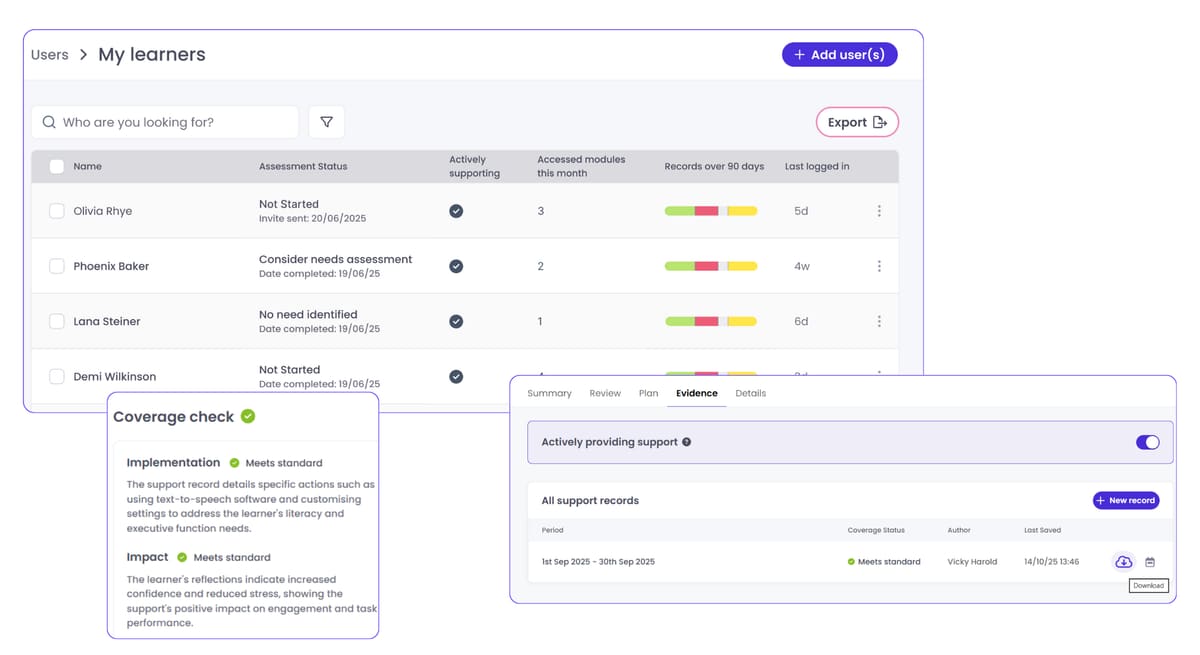
Reasonable adjustments are delivered in everyday teaching, by the tutor who already knows the learner, not routed to a specialist queue. The Coverage Checker scores every support record in real time against the Three I's (Intent, Implementation, Impact), so audit-grade evidence becomes a by-product of good practice, never a document reconstructed before an audit.
- Green meets the standard, amber needs improvement, and red is blank, never incomplete.
- It scores support records, not an Ofsted report: your professional judgement stays in charge.
- The third link of the golden thread, from assessed need to delivered support.
Every learner gets an on-demand AI learning coach
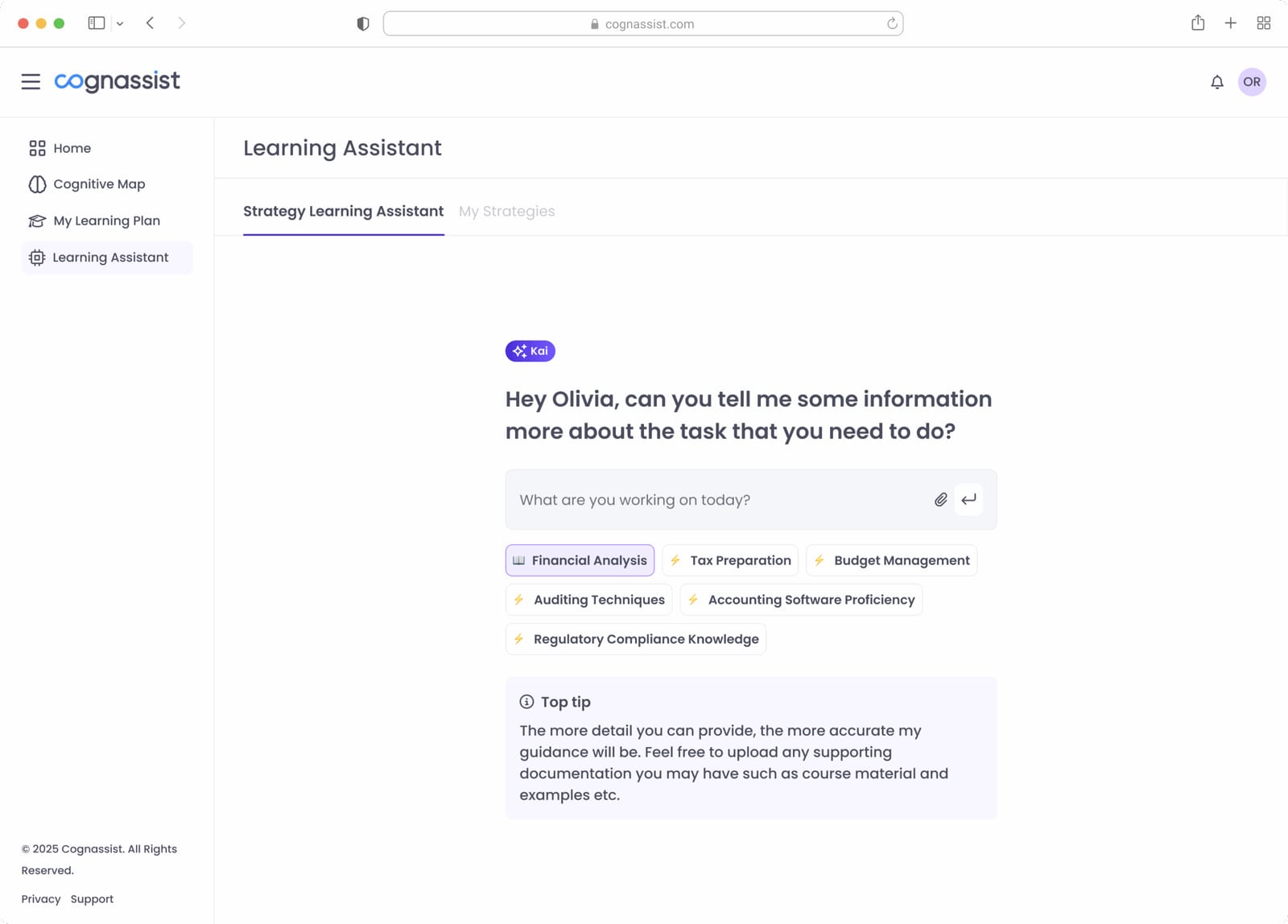
Kai's Learning Assistant gives every learner cognitively personalised task strategies on demand, not just those with an identified need, and stays available even after a learner steps off proactive support. Describe a task, and Kai returns a strategy scaffolded to that learner's own cognitive profile.
- A self-serve module library, roughly four new modules a month, travels alongside it.
- Every strategy ties back to the learner's own profile through a Cognition Alignment panel.
- Live for learners today. A tutor-facing Kai is on our roadmap, not built yet.
Inclusion that reaches the whole class, not just one learner
Adaptify turns cohort-level barriers into group adaptations by delivery method, so a tutor teaching fifteen to twenty-five-plus learners with different cognitive profiles doesn't have to read every individual plan to teach inclusively. Co-produced with City & Guilds.
- Group and cohort-level, not individualised or automatic.
- A standalone tool at adaptify.cognassist.io, open signup, separate from the main Cognassist app.
- Only a manual data link exists today, arranged by your customer success manager (CSM), not an automatic sync.
One real-time view of inclusion, built for the people accountable for it
Insights gives leaders a single, real-time view of the whole APDR cycle (assess, plan, do and review): adoption, the proactive-support pathway, evidence-quality trends and timeliness, assembled automatically. That's the data for the self-assessment report (SAR), quality improvement plan (QIP), board assurance and the inspection narrative, without reconstructing it by hand.
- A leadership surface built for the people accountable for inclusion, not a tutor's dashboard.
- Admin-only: it never implies every tutor or manager sees it.
- It helps you evidence inclusion; it does not make you compliant, and no regulator requires or approves it.
Confident, inclusive teaching without depending on a specialist team
Cognassist Training delivers role-based, just-in-time continuing professional development (CPD) in the flow of work: an on-demand course library plus an in-app drawer, so staff learn at the point of need, not once a year.
- Role-based recommendations for tutors, coaches, champions and inclusion leads.
- A completion team report for admins and tutor managers: a completion view, not a capability-uplift metric.
- Closes the practitioner-confidence gap that otherwise undermines whole-provider inclusion.
Every capability above rests on validated science, not a marketing claim
The cognitive assessment is standardised on 26,301 UK apprentices, reviewed by the Professional Association of Teachers of Students with Specific Learning Difficulties (PATOSS) against Joint Council for Qualifications (JCQ) criteria, and developed with an independent Science Advisory Board. Reliability runs .78 to .93 internal consistency across the indexes. The full detail, and the honest limits, sit on their own page; we don't re-argue them here.
How the whole cycle connects, the golden thread
This is the whole platform's method, not one page's stage. Assess, plan, do and review connect end to end: the assessed need traces through the plan, the delivered adjustment and the evidence, all the way to leadership oversight. Read backwards, any support record traces back to an assessed need.
Step 01 of 05
Assess
Every learner completes the cognitive assessment at enrolment, surfacing cognitive strengths and needs across the whole cohort.
- A cognitive diversity report on every learner
Step 02 of 05
Plan
Suggested adjustments become a personalised support plan, drafted in minutes and co-created with the learner.
- Built from the assessed need, agreed together
Step 03 of 05
Do and review
Tutors deliver the agreed adjustments in everyday teaching, and the Coverage Checker scores every record in real time.
- Audit-grade evidence as a by-product
Step 04 of 05
Lead
Leaders see the whole cycle roll up into one real-time view and steer inclusion across the provider.
- Admin-only, whole-provider oversight
Step 05 of 05
Train
On-demand, role-based continuing professional development (CPD) builds the confident non-specialists who make every stage deliverable.
- A capability layer, not a fifth step
- 400,000+
- learners assessed (as of 2026)
- 150+
- organisations supporting learners
- Since 2017
- in education and skills
- Levels 1 to 7
- supported
Customer story · University of Exeter
One provider running the whole platform, not a point tool
The University of Exeter uses Cognassist across induction, achievement tracking and funding compliance for 3,800 apprentices, not a single point solution bolted onto one part of the journey.
“Lots of organisations use different tools, but Cognassist is a key factor for us and one part of the reason for our high achievement rates - currently over 80% - above the national average.”
- 80%+achievement rate, above the national average
- 3,800apprentices, grown from 16
- ConfidentLearning Support Funding (LSF) compliance
Cognassist has been a real game-changer for us... the ability to evidence the support consistently... identify hidden needs and provide tailored support
Explore the platform
Go deeper on any part of the platform
Every capability above links to its own page. Six more to explore, plus the short version.
The cognitive assessment
Whole-cohort, no specialist: nine domains, three indexes, and the report a tutor acts on.
ExploreThe support plan
A personalised plan drafted in minutes, co-created with the learner.
ExploreReasonable adjustments
Delivered in everyday teaching, evidenced automatically with the Coverage Checker.
ExploreLeadership inclusion insights
One real-time, admin-only view of inclusion across your whole provider.
ExploreCognassist Training
On-demand, role-based CPD that builds confident inclusive teaching.
ExploreThe science and evidence
The normative sample, reliability, validity and independent scrutiny behind every score.
ExploreThe platform, in brief
Prefer the short version? See the whole platform in five minutes.
Explore
FAQ
The questions buyers actually ask about the whole platform
What does Cognassist actually do?
Cognassist operationalises the whole graduated approach, assess, plan, do and review, as one platform across four pillars: Assess, Plan, Do & review, and Leadership & Governance. This page is the full platform overview: every capability, honestly labelled live, partial or coming soon.What is the Cognassist cognitive assessment?
A whole-cohort cognitive assessment every learner completes at enrolment, no specialist required. It measures nine cognitive domains across three indexes and produces a strengths-forward cognitive diversity report plus a signal for a tutor's professional judgement, never a diagnosis.What is Plan360?
Plan360 is Cognassist's name for the support plan: drafted in minutes by a non-specialist, built from the assessed need, and agreed with the learner as a starting point, never a finished document.What is ProAdapt?
ProAdapt is Cognassist's name for reasonable-adjustments delivery: adjustments delivered in everyday teaching by the tutor who knows the learner, each carrying its Intent, Implementation and Impact.What is the Coverage Checker?
It scores every support record in real time against the Three I's, Intent, Implementation and Impact, with a simple red, amber, green signal: green meets the standard, amber needs improvement, red is still blank. It coaches record quality; it does not generate an Ofsted report.What is Cognassist Insights?
A real-time, admin-only view of inclusion across your whole provider: adoption, the proactive-support pathway, evidence quality and timeliness, assembled automatically for governance, self-assessment and inspection.What is Cognassist Training?
On-demand, role-based continuing professional development, built into the same platform your staff already use, so tutors, coaches and leaders build inclusion capability in the flow of work, not in a separate course once a year.Does Cognassist have an AI coach for tutors, like it does for learners?
Not yet. Kai's Learning Assistant is live for learners today. A tutor-facing Kai surface is on our roadmap, not built; we won't call it current until it is.What is Adaptify, and is it part of the main platform?
Adaptify is a separate, standalone tool at adaptify.cognassist.io, open signup, co-produced with City & Guilds. It turns cohort-level barriers into group lesson adaptations. Only a manual data link, arranged by your customer success manager, exists into the main platform today, not an automatic sync.How does Cognassist evidence inclusion for Ofsted?
Every stage builds a golden thread from the assessed need through the delivered adjustment to leadership oversight, so evidence is a by-product of everyday practice, not reconstructed before an inspection. It helps you evidence inclusion; it does not make you compliant, and no regulator requires or approves it.Is Cognassist validated?
Yes. It's independently reviewed and standardised on a large UK sample. See the full validation detail, including the honest limits, on our science and evidence page.Will this replace our MIS or e-portfolio?
No. Cognassist sits alongside the management information system (MIS) or e-portfolio you already run, as a complement, not a replacement. We don't assert specific data flows without a technical call.Is any of this a diagnosis?
No. Every signal Cognassist produces, from the cognitive assessment to a classification, informs a tutor's professional judgement. It's never a diagnosis, and it doesn't by itself establish disability under the Equality Act 2010.
See the whole platform on your own provision
You've read the whole platform. Book a demo and we'll show it working end to end, on the kind of learners and course structures you actually run.